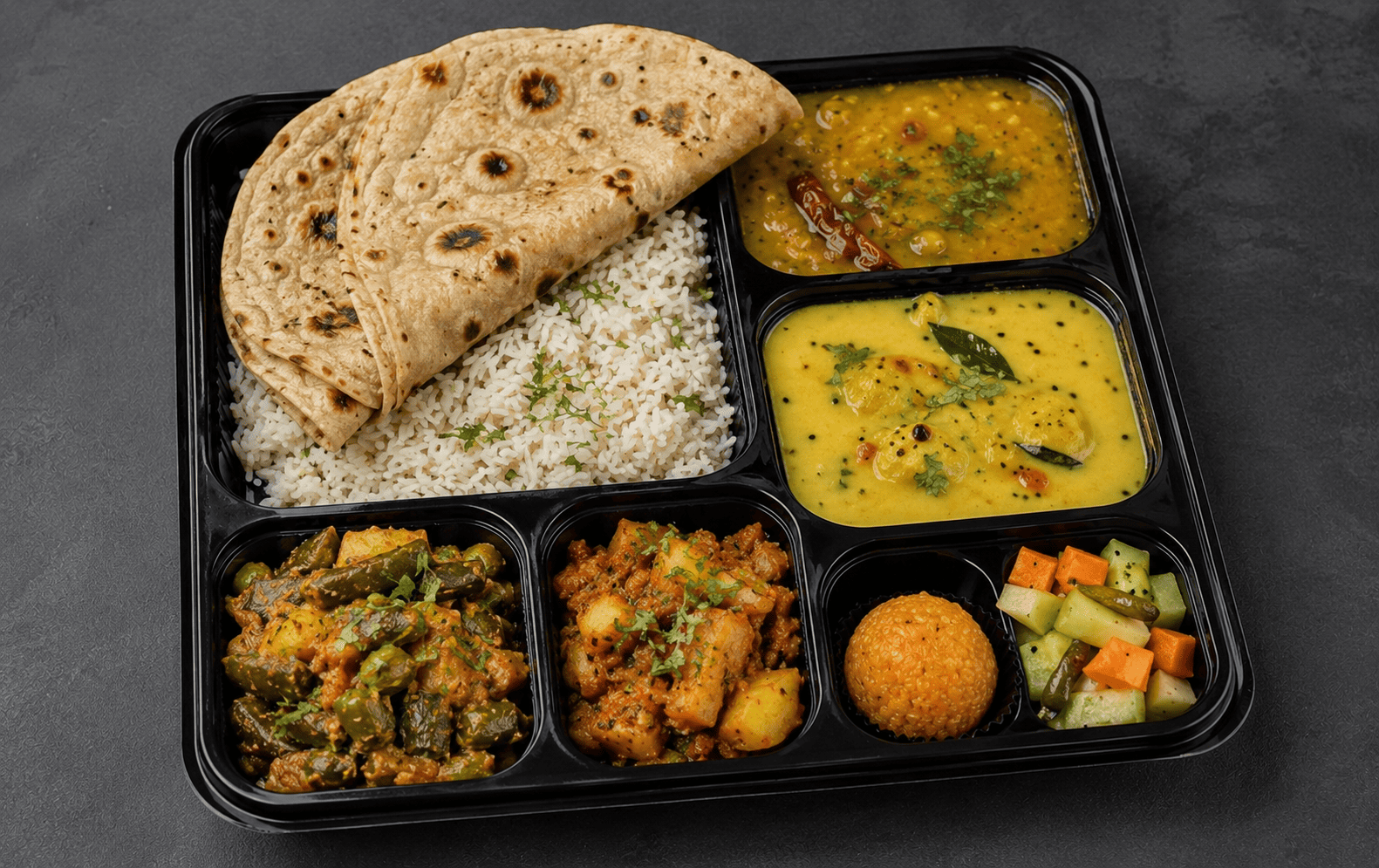
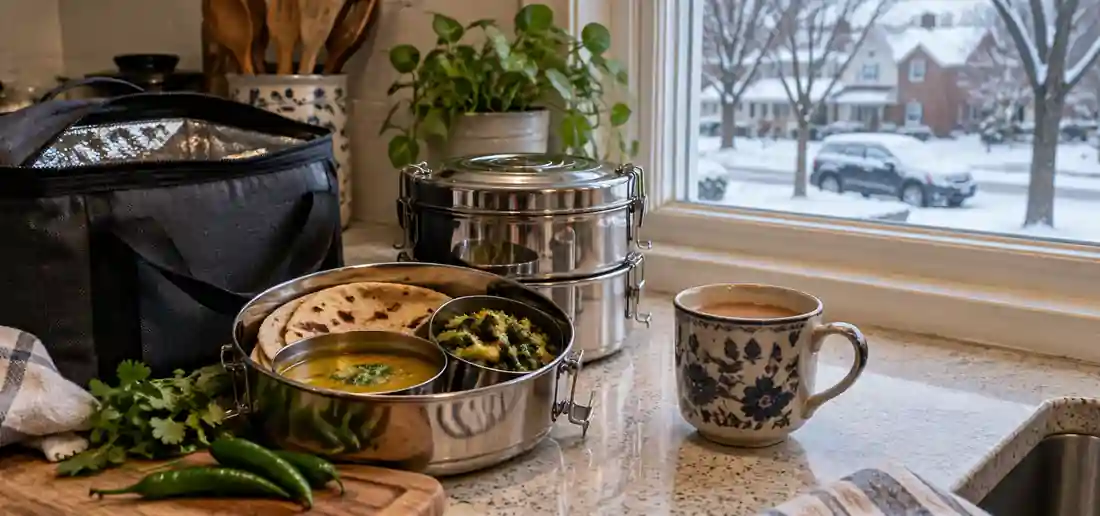
The first winter in Canada is when most newcomers start searching for an Indian tiffin service in Canada. The rent is high, the grocery run takes an hour on the bus, and the roti never tastes like it did at home. Across Brampton, Mississauga, Surrey, Calgary, and Winnipeg, home cooks have quietly built a tiffin economy that solves this: a daily dabba of dal, sabzi, roti, and rice delivered to your door or your office for roughly the price of one fast-food combo. This guide explains how tiffin services work in Canada, what they cost, how to find a reliable one as a student or newcomer, and what to know if you want to start cooking tiffins yourself.
How tiffin services work in Canada
The model is the same one that runs in every Indian city, adapted to Canadian distances and weather. A home cook or small kitchen sets a weekly menu, you subscribe for a week or a month, and the food arrives in a sealed container at a fixed time.
Who is cooking
Most Canadian tiffin vendors are home kitchens, often run by women cooking Gujarati, Punjabi, Marathi, or South Indian food from a family recipe book. A smaller number are restaurants that sell subscriptions only, and a few have grown into commercial kitchens producing several hundred tiffins a day. Platforms and distributors now connect many of these kitchens to customers across the Greater Toronto Area and Metro Vancouver.
How delivery works
In dense suburbs like Brampton or Surrey, the cook or a family member drives a route. In bigger cities, distributors collect from several kitchens and deliver to condo lobbies, office buildings, and university residences. Some kitchens offer pickup from their home or a nearby plaza at a discount, which is common for students.
How ordering works
Many kitchens still take orders through a WhatsApp group by a morning cutoff. Others use order forms or a listing platform. Payment is usually e-transfer, weekly or monthly in advance.
What an Indian tiffin costs in Canada
Prices depend on the city, the cuisine, and whether delivery is included. Reported prices in Ontario sit around CAD 12 for a weekday lunch box from a home kitchen, and that is a fair anchor for most of the country. These are planning ranges, not quotes.
| Plan | Typical per-meal price | Monthly (20–22 days) | Notes |
|---|---|---|---|
| Veg lunch or dinner, pickup | CAD 9 – 12 | CAD 190 – 260 | Cheapest option; common near campuses |
| Veg, delivered | CAD 11 – 15 | CAD 230 – 330 | Delivery built into price or added per week |
| Non-veg (chicken 2–3 days a week) | CAD 13 – 17 | CAD 280 – 370 | Usually from licensed or commercial kitchens |
| Two meals a day | CAD 20 – 28 | CAD 420 – 600 | Often one delivery with lunch and dinner together |
Compare that with CAD 15 to 20 for a single takeout meal with tax and tip, and the maths is clear. A monthly veg tiffin is roughly what two weeks of lunches from a food court would cost.
Finding a reliable tiffin service as a student or newcomer
The hard part in Canada is not whether tiffin services exist; it is finding the good one in your area when you do not yet know anyone. Here is what works.
Start with the trial, not the month
Almost every kitchen will sell a single day or a week. Order on a normal weekday and check three things: whether the roti is still soft by the time you eat, whether the portion is enough, and whether it arrived in the window promised. Only then pay for a month.
Ask about winter delivery
This is the Canada-specific question. Ask what happens on a snow day, whether delivery times shift in winter, and whether the food is packed to stay warm. Kitchens that have been through a few winters have an answer; new ones often do not.
Check the cuisine matches your home
Gujarati, Punjabi, Marathi, Tamil, and Bengali tiffins are all available in the big metros, but an “Indian tiffin” listing can mean anything. Ask for the weekly menu and look for the dishes you actually miss.
Ask about allergens and dietary needs
Jain, vegan, no onion-garlic, and nut-free options are all possible, but confirm before the trial. Canadian customers also ask about gluten more often than Indian ones; a kitchen that can answer clearly is one that takes food safety seriously.
Food safety and licensing: what to know as a customer
Food rules for home kitchens vary by province and are enforced by local public health units. In general, home-based food businesses need at least a food handler certificate, low-risk foods face lighter rules, and high-risk foods such as meat and refrigerated items usually require a commercial kitchen. In practice, many tiffin cooks operate informally.
As a customer, that means asking two simple questions: does the cook hold a food handler certificate, and where is the food cooked? A home cook with a certificate, clean packaging, and a consistent delivery record is a reasonable choice for vegetarian food. For non-veg, prefer a kitchen that can show it is licensed.
Starting a tiffin service in Canada: the short version
If you are the person everyone asks to cook for Diwali, you may be sitting on a business. Canadian tiffin kitchens that started with ten customers in a WhatsApp group have grown to hundreds of meals a day. Here is what the first month looks like.
Get the paperwork right first
- Complete a food handler certification course; most provinces offer one online in a few hours.
- Contact your local public health unit and ask what a home-based food business in your municipality needs. The answer differs between, say, Peel Region and Surrey.
- Register the business and open a separate account for e-transfers so your books are clean from day one.
- If you plan to cook meat, assume you will need commercial kitchen space, even if it is a few hours a week in a shared kitchen.
Start small and local
A fixed weekly veg menu, ten to fifteen customers within a short drive, pickup or one delivery route, and a morning order cutoff. Scale only after a full month with no missed deliveries. The kitchens that grew fastest in Canada did it through referrals inside one community, not through ads.
Get found by people who are already searching
Newcomers search online before they know anyone to ask. Listing your kitchen on TiffinWorld is free and puts your menu, cuisine, plans, and area in front of customers in your city who are looking for exactly what you cook. Customers send you an inquiry and you deal with them directly.
Where tiffin services are easiest to find in Canada
You will find Indian tiffin kitchens in almost every city with a South Asian community. The densest clusters are:
- Greater Toronto Area: Brampton, Mississauga, Scarborough, Etobicoke, North York, Burlington, and Hamilton
- Metro Vancouver: Surrey, Delta, Abbotsford, Burnaby, and Vancouver proper
- Alberta: Calgary NE, Edmonton, and increasingly Red Deer
- Prairies and Atlantic: Winnipeg, Regina, Saskatoon, Halifax, and university towns like Moncton and St. John's, where a few kitchens serve mostly students
Outside the metros, the choice is thinner and the cook may be the only one in town. Those kitchens are often the best value and the most flexible.
Frequently asked questions
How much does a tiffin service cost in Canada?
Roughly CAD 9 to 15 per vegetarian meal depending on city, pickup versus delivery, and portion size. Reported home-kitchen lunch boxes in Ontario are around CAD 12. Monthly veg plans typically land between CAD 200 and 330.
Do tiffin services in Canada deliver to student residences?
Many do, usually to the building entrance at a fixed time. Kitchens near universities often offer pickup discounts and group plans for roommates.
Is tiffin food in Canada the same as in India?
Mostly. Ingredients like fresh methi or specific gourds can be seasonal or pricier, so menus adapt, but Gujarati, Punjabi, Marathi, and South Indian home kitchens cook the same way they did at home.
Can I pause my tiffin when I travel?
Most kitchens allow skip days with a day's notice. Confirm the policy before paying for a month.
Do I need a licence to start a tiffin service from home in Canada?
Rules are set by province and enforced by local public health units. At minimum expect a food handler certificate; vegetarian, low-risk food has lighter rules, while meat and refrigerated items generally need a commercial kitchen. Ask your local unit before you start.
How do I find a tiffin service near me in Canada?
Ask in your community or temple WhatsApp groups, and search by city on TiffinWorld, where kitchens list their cuisine, menu, and plans so you can compare before messaging anyone.
Find home food in your new city
You do not have to wait until you know someone to eat well. Browse Indian tiffin kitchens near you on TiffinWorld, compare menus, and send a trial inquiry. If you cook, list your kitchen for free and let newcomers and students in your area find you. For a general checklist before you choose, read how to choose a tiffin service near you.