The phone call usually goes the same way. Your mother says she "ate something", your father says the maid did not come, and you are in Bengaluru, Dubai, or Toronto wondering what they actually had for lunch. A tiffin service for elderly parents is the most practical answer to that worry: one home kitchen near them, cooking the kind of food they grew up eating, delivered at the same time every day, paid for by you from wherever you are. This guide covers how to arrange it from a distance, what to ask a kitchen when the customer is seventy-five and not twenty-five, how to handle soft food and low-salt needs, and how to keep an eye on it once it is running.
Why a tiffin works better than the alternatives
Families usually try three things before a tiffin: a cook who comes daily, a food-delivery app with a shared account, or the neighbour who "keeps an eye". Each has the same failure point: it depends on someone showing up or someone remembering. A monthly tiffin removes the daily decision. The food is cooked, packed, and at the door at 12:30 whether anyone thought about it or not.
Consistency matters more than variety
Older parents often eat less, eat earlier, and like the same five or six dishes. A good home kitchen will happily cook a narrower rotation for them. That predictability is a feature, not a limitation.
A daily visit is a daily check
The delivery person is at the door every day. Most home kitchens will tell you if the tiffin was not collected, if your father seemed unwell, or if yesterday's box came back untouched. That is a quiet safety net no app provides.
It is cheaper than a cook
A full-time or part-time cook in an Indian metro costs ₹6,000 to ₹15,000 a month plus groceries. A two-meal tiffin for one person runs ₹4,500 to ₹8,000 all in, and nobody has to manage the kitchen.
What to ask a kitchen when the customer is elderly
The questions are different from the ones you would ask for yourself. Portion size and spice matter less; softness, salt, timing, and reliability matter a lot more.
Can they cook soft, low-oil, low-spice food every day?
Many older people have dentures, reduced appetite, or digestion that does not tolerate a heavy tadka. Ask whether the kitchen can do soft rotis or phulkas, well-cooked dal, khichdi two or three times a week, and sabzis without large hard pieces. A kitchen that already cooks for elderly customers will say yes without hesitation.
Can they follow a doctor's instructions?
If your parent has been told to reduce salt, sugar, or oil, or to avoid certain foods, the kitchen needs to be able to follow that consistently. Share the instruction in writing, keep it simple, and ask the kitchen to confirm it back. Do not expect a home cook to design a medical diet; do expect them to follow a short list of rules reliably.
What time exactly does it arrive?
Older parents eat lunch at 12:30, not 2:00, and dinner at 7:30, not 9:30. Ask for a tight delivery window and ask what happens when it slips. The kitchen that messages you (not just your parent) when it is late is the one to choose.
Steel or disposable, and who handles the containers?
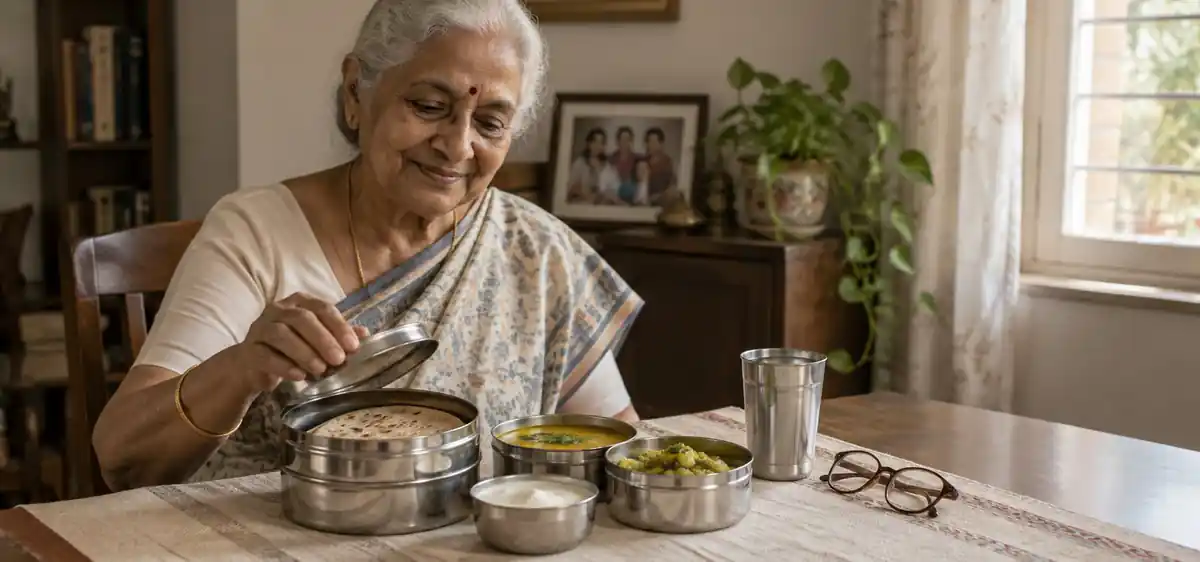
Steel dabbas are better food and less waste, but someone has to wash and return them. If your parent cannot manage that, ask for disposables or for the delivery person to collect the previous day's box.
Will they tell you when something is off?
Say it plainly: "If the tiffin is not collected or comes back full, please call me." Most home kitchens are glad to do this. It takes a minute and it is the single most reassuring thing about the whole arrangement.
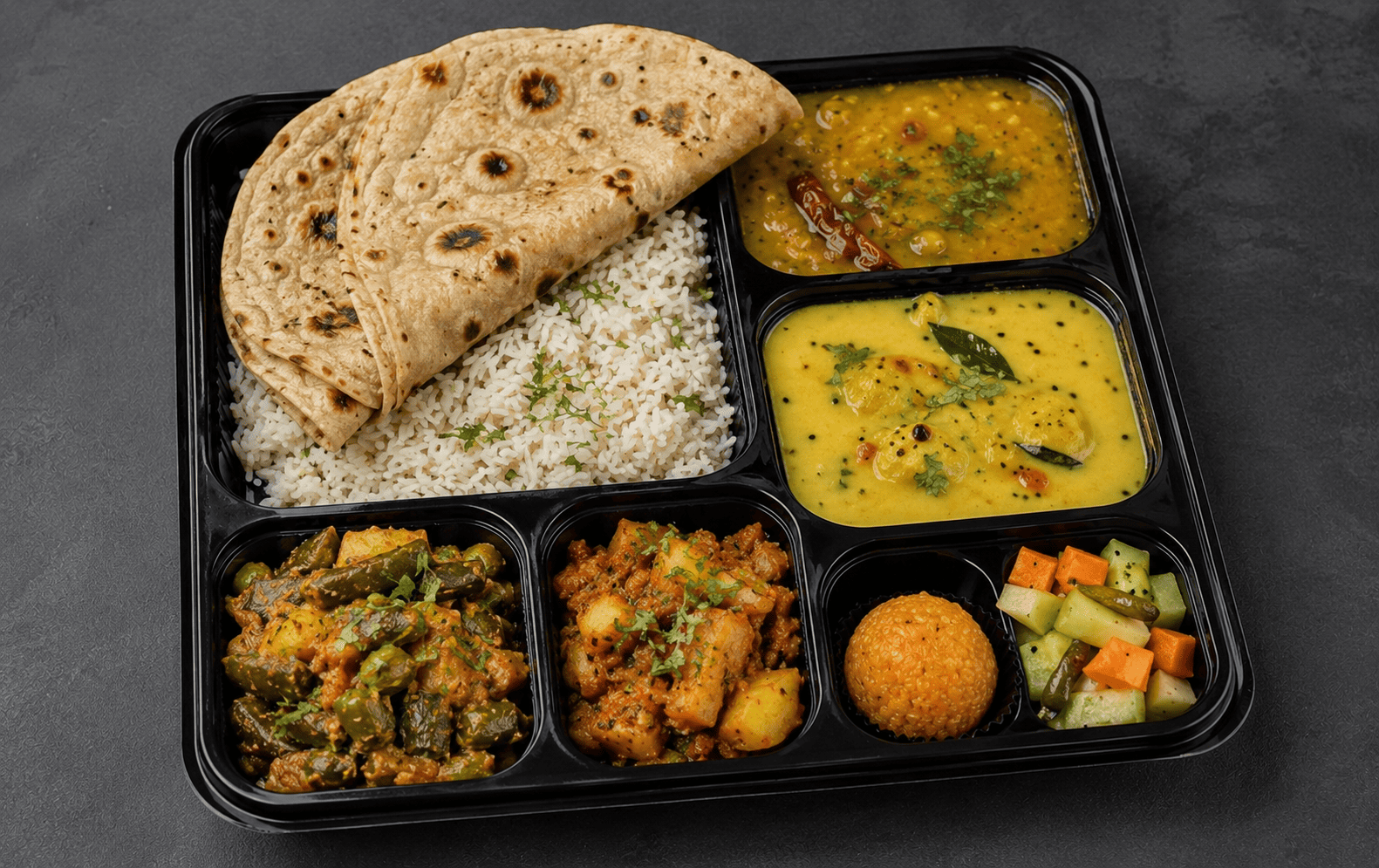
Lunch at 12:30, every day: soft phulka, dal, a light sabzi and curd from a home kitchen a few streets away.
A week of elder-friendly tiffin
Here is the kind of rotation a good home kitchen runs for older customers: familiar, soft, lightly spiced, and easy to reheat if needed. Swap in Gujarati, Punjabi, Maharashtrian, or South Indian equivalents.
| DayLunchDinner | ||
| Monday | Moong dal, lauki sabzi, soft phulka, rice, curd | Vegetable khichdi, kadhi, papad |
| Tuesday | Toor dal, tinda or parwal, phulka, rice | Dal dhokli or dal-rice with a little ghee |
| Wednesday | Masoor dal, bhindi (soft-cooked), phulka, salad | Tomato rice with curd, or upma with sambar |
| Thursday | Chana dal with lauki, mixed veg, phulka | Khichdi with ghee, buttermilk |
| Friday | Palak dal, aloo-matar (soft), phulka, rice | Vegetable pulao, raita |
| Saturday | Sambar, beans poriyal, rice, curd | Idli with sambar, or soft thepla with curd |
If your parent eats very little at dinner, many kitchens offer a smaller "half" dinner tiffin at a lower price. Ask.
Setting it up from another city or another country
You do not need to be there. Here is how NRIs and out-of-town children typically arrange a tiffin for parents in India.
- Shortlist two kitchens within a short distance of your parents' home. Distance matters more for elderly customers: a 2 km kitchen delivers on time in the monsoon; a 10 km one does not.
- Do a video call with the cook. Five minutes. You will know within two whether they have cooked for older people before.
- Order a one-week trial and ask your parent, or a neighbour, how it was. Specifically: was it soft enough, salty enough, on time.
- Write down the rules (low salt, no brinjal, lunch by 12:30) on WhatsApp so there is one message to point back to.
- Pay monthly by UPI or bank transfer from wherever you are. Most kitchens accept it; some NRIs set a standing instruction.
- Add the kitchen to a small WhatsApp group with you, your parent if they use it, and a local relative or neighbour as backup.
The same approach works for new parents
The other household that cannot cook for a few months is the one with a newborn. The needs are different but the solution is identical: a nearby home kitchen, a fixed menu, a fixed time, paid in advance.
- Ask for the traditional postpartum foods your family uses, such as light dals, ghee-rich rotis, methi, ajwain and jeera in the tadka, gond or panjiri on the side. Many home kitchens cook these on request for the first forty days.
- Ask for two meals plus a mid-morning portion, delivered in one trip, so the parents are not answering the door three times a day.
- Order for both parents. The one not feeding the baby is usually the one skipping meals.
Grandparents often arrange this tiffin as a gift when they cannot travel to help. It is one of the more useful things to send.
Finding an elder-friendly kitchen near your parents
You are not looking for the trendiest kitchen in the city; you are looking for a reliable one within a short drive of a specific address. TiffinWorld lets you search home kitchens by locality with their menus and plans, which is the fastest way to find two candidates near your parents' pincode when you are not there to ask around.
Search by their pincode, not yours
Enter your parents' pincode on the menu page and look for kitchens within two or three kilometres. Check the weekly menu for soft, simple dishes rather than restaurant-style gravies.
Filter for the cuisine they grew up with
Use the categories page to narrow to Gujarati, Punjabi, Maharashtrian, South Indian, or Jain. Familiar food is eaten; unfamiliar food comes back in the box.
Put the rules in the inquiry
Write the delivery address, the time window, and the two or three dietary rules in the inquiry itself. The kitchen replies to you directly and can confirm before you pay for a trial.
Frequently asked questions
How much does a tiffin service for elderly parents cost?
Roughly ₹110 to ₹170 per meal in most Indian cities, or ₹4,500 to ₹8,000 a month for lunch and dinner. Half-portion dinners and single-meal plans cost less. Prices vary by city and kitchen.
Can I pay for my parents' tiffin from abroad?
Yes. Most home kitchens accept UPI or bank transfer, and many NRIs pay monthly in advance from an Indian account or via a relative.
Can a tiffin service follow a low-salt or diabetic-friendly diet?
Many home kitchens can follow a short, clear list of rules, such as less salt, no sugar in sweets, less oil. Share the doctor's instructions in writing and confirm with the kitchen before the trial. For strict therapeutic diets, confirm with the doctor what is practical for a home cook.
What if my parent does not collect the tiffin?
Ask the kitchen in advance to call you if the tiffin is not collected or comes back untouched. Most will. Add a neighbour or relative to the WhatsApp group as a local backup.
Will the kitchen cook soft food?
Kitchens that serve elderly customers routinely make soft phulkas, well-cooked dals, and khichdi. Ask directly; the answer tells you a lot about their experience.
Can I order a tiffin for a new mother?
Yes. Many home kitchens cook traditional postpartum meals on request, including ghee-rich rotis, light dals, methi, and panjiri. Mention it in the inquiry.
Arrange it this week
Stop guessing what your parents ate today. Find home kitchens near their pincode on TiffinWorld, send one inquiry with the delivery time and dietary rules, and start with a one-week trial. If you want a general checklist first, read how to choose a tiffin service near you, and if your parents are abroad, see our guide to Indian tiffin services in Canada.